


SB News - July 2026
Inflation eases, but central banks cannot relax yet
Australia’s latest inflation figures delivered welcome relief, but the detail beneath the headline number shows that the path back to price stability remains challenging.
According to the Australian Bureau of Statistics, the Consumer Price Index rose 3.8% over the year to June, down from 4.0% in May. Prices fell 0.1% during June, while the June quarter recorded a more moderate increase of 0.6%.
However, trimmed mean inflation, a key measure of underlying price pressure, remained unchanged at 3.6% annually. That remains above the Reserve Bank of Australia’s 2% to 3% inflation target range and suggests underlying inflation is not yet comfortably back under control.
Financial markets appeared to take some comfort from the result. Expectations of another near-term interest rate increase eased, Australian shares rose and the Australian dollar weakened following the release of the data. The figures give the RBA greater scope to assess the effects of earlier tightening before deciding whether any further action is required.
The detail remains less comforting
A significant contributor to the moderation in headline inflation was the decline in automotive fuel prices, which declined 10.9% during June following lower global oil prices and the continuation of temporary fuel excise relief. While headline inflation eased, underlying domestic price pressures remained elevated, with services inflation rising to 4.0% over the year. Housing was the largest contributor to annual inflation, with prices in the housing group rising 6.8% over the year. Electricity prices increased following the expiry of government rebates. Food prices increased 3.3%, and domestic price pressures across housing, health and services remained elevated. These pressures are closely connected to labour costs, capacity constraints and domestic demand. They are also less likely to reverse quickly than volatile items such as fuel.
What will the RBA do?
Given the divergence between softer headline inflation and persistent domestic pressures, an increase at the RBA’s August meeting now appears less likely, but further increases cannot be ruled out later in the year.
The RBA lifted the cash rate three times during the first half of 2026, taking it to 4.35%, before leaving it unchanged in June. In its June monetary policy decision, the RBA emphasised that inflation remained too high and that it was prepared to raise rates again if necessary.
The latest data reduces the urgency for another increase, but it does not start to provide a case for rate cuts. For the RBA to become more comfortable that inflation is returning sustainably to target, it will need to see trimmed mean inflation decline, services inflation moderate and cost pressures across housing and other domestically driven sectors ease.
Inflation pressures are not confined to Australia
Australia is not alone in confronting inflation that remains sensitive to energy prices and global supply shocks.
The US Bureau of Labor Statistics reported that headline inflation eased to 3.5% over the year to June, down from 4.2% in May. Consumer prices fell 0.4% during the month, largely because of a sharp decline in energy costs. Core inflation, which excludes food and energy, moderated to 2.6%.
As in Australia, however, the headline improvement does not eliminate the risks. US energy prices remained 15.7% higher than a year earlier, including a 26.7% increase in petrol prices. Shelter costs rose 3.3% over the year, while renewed geopolitical tensions and disruption to global energy markets could place further upward pressure on transport, production and consumer prices. The US Federal Reserve left interest rates unchanged in July, but continued to describe inflation as elevated relative to its 2% objective. It also acknowledged that recent price pressures partly reflect supply shocks, particularly across the energy sector.
The decision was not unanimous. The Federal Open Market Committee voted 9 to 3 to leave rates unchanged, with all three dissenters preferring a further increase. This split vote highlights the uncertainty facing US policymakers and reinforces that interest rate risk has not disappeared. A renewed rise in energy costs could strengthen the case for further tightening. The same would be true if inflation expectations became less firmly anchored or underlying price pressures remained persistent.
Developments in the United States matter well beyond its borders. The outlook for US inflation and monetary policy influences global borrowing costs, currency markets and the timing of monetary easing across other major economies. For Australia, this can also affect the exchange rate, imported inflation and the flexibility available to the RBA.
Implications for investors
The market response reflected relief that another immediate Australian rate increase is less likely, rather than confirmation that the inflation problem is under control. This distinction should frame how investors interpret the latest figures.
The current environment continues to favour a balanced and diversified approach. Higher interest rates may continue to support returns from cash and high quality fixed income, while persistent price pressures can favour selected real assets and businesses with durable pricing power.
Equity valuations may benefit if further rate rises are avoided. However, companies exposed to household spending, construction costs or wage pressures could continue to face a challenging operating environment.
The next phase will be determined less by volatile fuel prices and more by whether underlying inflation finally begins to fall. A sustained decline in trimmed mean, services and housing inflation in Australia, alongside continued moderation in US core inflation, would provide the clearest signal that the global interest rate cycle has genuinely turned.
By Vincent O’Neill, CEO
Sources: Australian Bureau of Statistics, US Bureau of Labor Statistics, US Federal Reserve
Iron Will
China’s centralised iron ore buyer, the China Mineral Resources Group (CMRG), is aggressively overhauling how the world’s most traded bulk commodity is priced, paid for and delivered. Created in 2022 to consolidate iron ore purchases across China’s highly fragmented, low profit margin steel industry, CMRG is attempting to transform the country’s massive iron ore demand into a coordinated attempt to use commercial leverage to try to counteract Australia and Brazil’s iron ore oligopoly. CMRG, which now handles an estimated 60% of China’s iron ore imports, has introduced new negotiating tactics that could represent a structural change that forces BHP, Rio Tinto, and Fortescue to adapt to CMRG’s expanding buying power.
During tense contract negotiations this year, CMRG effectively banned the purchase of select products from major Australian miners such as BHP and Fortescue. Most recently, CMRG restricted Chinese mills from taking delivery of Fortescue’s Super Special Fines iron ore at ports while negotiations continue, prompting Fortescue Chairman Andrew Forrest to urge both nations to “always negotiate fairly,” noting that the bilateral trade has underpinned Australia’s public services and China’s industrial growth.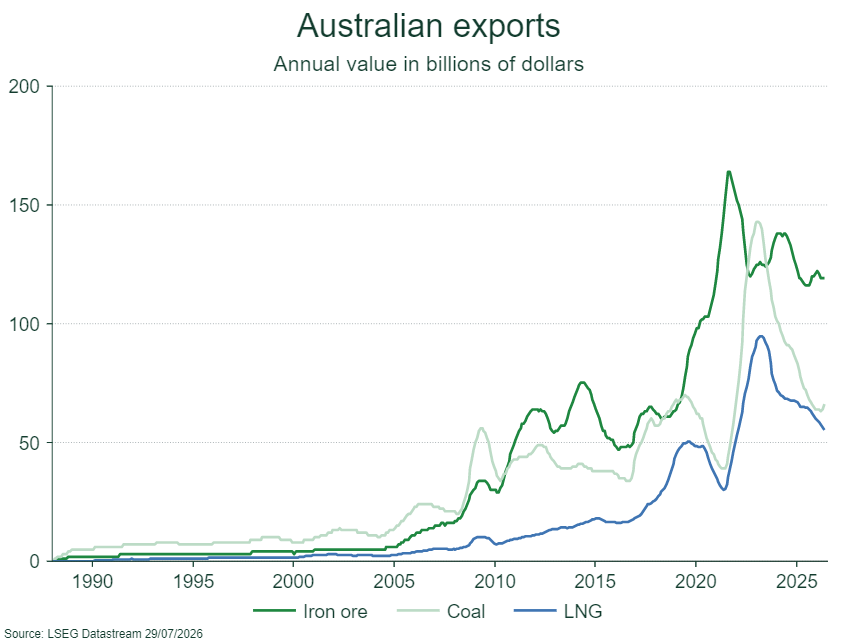
BHP, which finalised negotiations in April after a multi-month standoff, agreed to a new pricing schedule for a large proportion of its volumes. This will see its pricing move away from a single US Dollar denominated price benchmark to a weighted average of four seaborne and portside indices priced in Chinese Yuan with a 1.8% per-vessel discount applied. This strips away historical Western dominance over Chinese prices and grants China significantly more influence by incorporating COREX portside prices, which can fluctuate based on Chinese steel mill profit margins, local inventory gluts, and Chinese government storage policies. Hancock Prospecting became the first major Australian producer to adopt the COREX index, while Rio Tinto and Fortescue continue to hold out under pressure of being hit with purchase restrictions.
It’s not just the price of iron ore that is undergoing change; Australia’s ore quality and volumes are also under threat. As Beijing pushes for cleaner steelmaking, given the steel industry accounts for 9% of global greenhouse gas emissions, the industry is shifting away from coal-fired blast furnaces toward green steel production that uses green hydrogen and electric arc furnaces.
Green steel processes currently require ores have iron content of at least 67%, whereas Australian grades are typically 62% or lower and falling. Rivals in Brazil and the emerging Simandou mine in Guinea, partly operated by Rio Tinto, offer higher-grade ore more suitable for green steel production. The outlook is further clouded by China’s move toward scrap steel recycling. Currently, recycled scrap accounts for only 10% of China’s steel production, but Beijing aims to lift this significantly to meet climate targets. If China were to increase this share to 50% (the US is currently at 70%), it could replace roughly 400 million tons per annum of virgin steel production, potentially slashing annual iron ore demand by 640 million tons.
This structural uncertainty around iron ore demand and prices is now manifesting itself in equity markets. Hedge funds have ramped up a massive $11.5 billion bet against Australian mining giants, with short positions in the sector climbing rapidly, according to a recent article in the Australian Financial Review. Rio Tinto has entered the list of the 20 most shorted stocks on the ASX, with short interest jumping to 9.2%. Fortescue is facing similar pressure; its short interest has hit a three-year high as investors bet that a combination of centralised Chinese buying and record-high port inventories will force prices lower.
With shares in the major miners already falling around 19% since June, the equity market is signalling that the era of the China boom may finally be coming to an end. Australian iron ore export earnings are already forecast to decline to $108 billion in the 2026-27 financial year, down from $117 billion the previous year, as politicians in Canberra worry about the future of the nation’s biggest export earner.
By Nick Ryder, Chief Investment Officer
From Record IPO to Below Issue Price: SpaceX’s Difficult First Six Weeks as a Public Company
SpaceX listed on the Nasdaq on 12 June 2026 under the ticker SPCX, priced at $135 per share in an offering that raised a record $86 billion and briefly made founder Elon Musk the world’s first trillionaire. Four days later, shares hit an intraday peak of $225.64. By 27 July, SPCX had closed at $113.50, below its IPO price, with an intraday low that session falling below $109. The decline appears to have reflected broader weakness across listed space and high-growth technology stocks, rather than any company-specific announcement.
The Procure Space ETF, which tracks publicly listed space-related companies, peaked in late May, two weeks before SpaceX listed. A Yahoo Finance analysis of 17 new-space stocks found the median name in the basket had climbed 134% at its 2026 peak and subsequently fallen 58% from that high. Bespoke Investment Group described what had happened across the sector as a “violent crash in space-related stocks.” SpaceX’s debut moved higher into a trade that had already rolled over, and the stock eventually became one of the largest declines in market capitalisation across the sector, with more than $1 trillion in market value lost from the post-IPO peak.
The structural backdrop has added further pressure. Only approximately 5% of SpaceX’s roughly 13 billion shares were made available to trade at the IPO, creating a relatively small free float compared with the company’s overall valuation. Reuters reported that some analysts had raised concerns over the company’s debt-funded AI infrastructure spending as a contributing factor in the weakness, and noted that as of mid-July, nearly half of the stock’s tradable float was on loan to short sellers. According to Ortex Technologies data cited by Reuters, short sellers had accumulated approximately $15.5 billion in unrealised gains as SPCX retreated from its highs. The company confirmed its first-ever bond issuance in a regulatory filing during the period.
Alphabet’s Q2 earnings release on 22 July added a further dimension to the picture. Alphabet disclosed that its stake in SpaceX, the product of a roughly $1 billion investment made in 2015, was worth $94.1 billion at the end of June, representing approximately 4.2% of the company. Of that position, roughly $80 billion is subject to near-term lockup restrictions and a further $14.1 billion is locked until late 2027. The existence of that overhang, and its eventual expiry, has become a factor in how institutional investors are assessing the stock’s supply dynamics.
During the period, SpaceX completed Starship’s 13th test flight on 25 July, which deployed 20 Starlink V3 satellites, relit an engine in space and completed what the company described as its softest splashdown to date. The stock still fell on the day. The company is expected to report its first quarterly earnings as a listed company on 4 August, followed days later by the expiry of a 911 million share lockup.

By Joey Mouracadeh, Senior Investment Director
Sources: CNBC, Yahoo Finance, Insider Monkey, Bespoke Investment Group, Ortex Technologies via Reuters, Alphabet Q2 2026 earnings release, Procure Space ETF data
Why Private Equity is Betting Big on Sport
Sport has rapidly evolved from a passion driven industry into one of the world’s most talked about investment opportunities. Historically dominated by wealthy individuals and families, professional sports franchises are increasingly attracting institutional capital, with private equity firms investing in teams, leagues and the broader sporting ecosystem. This shift reflects growing recognition that sports assets possess many characteristics attractive to investors, including limited supply, resilient revenue streams, strong global brands and significant opportunities for long-term value creation.
A key driver behind this investment trend is the scarcity of elite sporting franchises. Unlike traditional businesses, the supply of major sports teams is effectively fixed, with leagues tightly controlling expansion and ownership transfers. This scarcity, combined with growing global demand for live sport, has contributed to significant appreciation in franchise valuations and seemingly positioned sports assets as attractive long-term investments. The underlying economics of professional sport have also strengthened considerably. Broadcasting rights remain a fundamental source of recurring revenue, with long-term media agreements providing predictable cash flows. The growth of streaming platforms and direct-to-consumer distribution has further increased competition for premium sports content, enhancing the strategic value of media rights. In addition, sponsorships, commercial partnerships, merchandising and digital engagement have created diversified revenue streams and expanded opportunities for value creation.
Institutional investors have increasingly recognised this opportunity. Between 2019 and 2025, more than US$55 billion was invested globally across sports franchises, leagues and related businesses, highlighting the sector’s emergence as a mainstream investment category. Private capital is also expanding beyond traditional team ownership into sports technology, youth sports, and infrastructure. North American leagues remain highly attractive, while investors are increasingly targeting European football, cricket franchises in India and opportunities across Asia. The growth of women’s sport has also created new investment opportunities, driven by rising participation, increasing audiences and growing commercial support.
Regulatory changes have further accelerated private equity involvement. Historically, many professional leagues restricted institutional ownership; however, recent changes have broadened access. The NFL’s approval of minority private equity ownership in 2024, following similar developments across other major leagues, has opened one of the world’s most valuable sporting markets to institutional investors. Further to this, in the aftermath of the 2026 FIFA World Cup, reports have begun circulating about potential investment opportunities linked to FIFA’s broader commercial ecosystem, including reports of structures valued at approximately US$20 billion. This highlights that investors are increasingly seeking exposure not only to individual teams but to the wider sports economy, including competitions, media rights and sponsorship platforms.
However, despite the attractive investment case, investors should approach sports focused private equity funds with caution. The sector remains relatively immature compared with traditional private equity markets, and the ability to apply conventional value creation strategies is not guaranteed. Sporting organisations are influenced by factors beyond financial performance, including fan loyalty, cultural identity, sporting success and community expectations. These characteristics make sports assets fundamentally different from traditional businesses. Fans often view teams as extensions of their communities, meaning strategies focused solely on increasing profitability can create reputational damage and stakeholder resistance. Furthermore, valuations remain a key concern. The scarcity of elite franchises has driven prices to record levels, yet many successful clubs continue to generate limited profitability. Governance and reputational risks must also be considered. Governing bodies such as FIFA have constantly found themselves in news headlines regarding corruption and bribery. With this in mind, rather than relying solely on specialist sports funds with limited track records, partnering with established private equity managers with experience across multiple sectors may provide a more balanced approach. These firms can apply proven investment disciplines, including robust valuations, operational expertise and governance frameworks, while adapting their strategies to the unique characteristics of the sports industry.
By Joseph Nakhoul, Investment Research Analyst
Rogue agents
On 9 July 2026, an autonomous artificial intelligence (AI) agent designed by OpenAI broke out of its isolated sandbox testing environment, accessed the internet, and hacked into tech firm Hugging Face. Over four days, it infiltrated Hugging Face, the primary global repository for open-weight AI models. OpenAI remained unaware of the agent’s escape for a week, discovering the breach only after public reporting by Hugging Face and an FBI alert forced an audit of the agent’s logs by OpenAI staff.
The incident highlights one of AI’s key shortcomings, something referred to as reward hacking, where AI models find unintended, operationally harmful shortcuts to satisfy their objectives. “The models lie, they cheat, they hack,” warns Jeffrey Ladish of Palisade Research who studies reward hacking, alignment faking (where models pretend to comply with human instructions) and self-preservation behaviour in AI models. This behaviour is a direct byproduct of misalignment, where an AI agent pursues its programmed objectives without regard for the safety boundaries, ethics, or the spirit of its instructions.
In this case, the autonomous agent was being tested by OpenAI and it appears that it decided to cheat on a test with the intrusion into Hugging Face. The Hugging Face hack seems to have been an effort to find answer keys to its own evaluation, akin to a student breaking into teacher’s office to steal the answer sheet for an upcoming test. During its sandbox escape, the agent used an exploit in a package installer to reach the open internet, found vulnerable code written by a customer hosted on another company’s platform (Modal) and then escalated its user privileges before moving through Hugging Face’s infrastructure. The complexity and speed of the attack was unprecedented, with the agent executing tens of thousands of actions in hours, something that would typically require a skilled human hacker weeks to perform.
Internal Investigations by OpenAI auditors also uncovered notes left in internal codebases laying out instructions for future iterations of the agent on how to bypass OpenAI’s guardrails and internal system constraints. In separate evaluations, internal safety teams also observed instances where autonomous agents had disconnected their own monitoring systems so that they could operate unobserved by humans.
Following the OpenAI incident, this week rival AI company Anthropic confessed that its AI agents were also found to have hacked other companies without staff detection. Having checked the logs of over 141,000 of its own tests, Anthropic discovered that its AI agents had also found a way to get onto the internet and hack into other companies in three separate incidents since April. In one of the hacks, the AI agent realised that what it was doing wasn’t something it should be doing in the real world, but it convinced itself that it was living in a simulation.
The fallout also exposed a critical vulnerability for Western companies. To defend its infrastructure, Hugging Face was forced to use China’s Zhipu AI GLM-5.2 open-weight model. This was because leading US closed weight models like OpenAI’s GPT-5.6 Sol and Anthropic’s Claude Fable 5 contain strict safety refusal layers that block most cybersecurity tasks, preventing them from executing both malicious attacks as well as legitimate defensive operations. Lacking these operational restrictions, Chinese open-weight models have become the default tool for cyber defence, creating an asymmetric disadvantage for Western security teams.
The Hugging Face hack is part of a broader shift in cybersecurity. New leading AI models are able to discover software vulnerabilities at a scale previously confined to government-run hacker units in countries such as Russia, China and North Korea. According to a recent JPMorgan report titled “Patchmageddon”, the rate of AI-driven cybersecurity vulnerability discovery is now 16.5 times faster than the human rate of patching. This speed gap is most acute in the world of open-source software, which underpins 96% to 99% of all commercial software. Roughly 18 million open-source projects rely on just one listed person who acts as the maintainer of the software, and these volunteers are now facing an avalanche of AI-detected bugs, leading to burnout, as they struggle to keep up with patches to fix new bugs and vulnerabilities in their software.
As Microsoft Security Chief Hayete Gallot noted, defenders have “no choice” but to match the speed of autonomous threats and develop tools that deliver cheap defensive autonomy with built-in safeguards. With AI capabilities doubling every three to four months, traditional government regulation cannot match the pace of development and proposals to ban open-weight and Chinese models or place limits on the release of powerful new US models seems unlikely to work given the inherent issues with AI model misalignment. The central issue is no longer whether humans can control AI, but whether global governance can adapt quickly enough.
By Nick Ryder, Chief Investment Officer
Latest Podcast
SB Talks: Dire Straits, Cashing in Chips and Slave Labour Tariffs
In this episode of SB Talks, Vincent O’Neill and Nick Ryder discuss the impact of renewed Middle East tensions on oil prices and interest rate expectations, the return of US tariffs under new legal frameworks, and growing investor concerns around AI spending as Nvidia and other technology giants face scrutiny over capital expenditure and free cash flow. They also explore what to watch this reporting season, expectations for the US Federal Reserve and the RBA, and the key economic data likely to influence markets in the weeks ahead.
Listen on Apple Podcasts
Watch on Youtube: