


SB News - June 2026
Wishy Warsh and the Maestro
The appointment of Kevin Warsh as chair of the Federal Reserve marks a pivot away from the hyper-transparent communication regime that has defined central banking for many years. As the world mourns the passing of former Fed chair, Alan Greenspan at age 100, comparisons between the two leaders have naturally surfaced. Greenspan is often referred to as the “Maestro”, which was coined by journalist Bob Woodward, who published a book in 2000 titled Maestro: Greenspan’s Fed and the American Boom covering Greenspan’s legendary status during his eighteen-year tenure as Federal Reserve chair. Warsh has openly declared his intention to follow in the footsteps of the Maestro, aiming to restore a communication model that avoids providing definitive, rigid answers about future interest rate paths by adopting a speaking style that deliberately mirrors Greenspan’s famous inconsistent mumbling.
Central to this transformation is the systematic dismantling of forward guidance, a tool Warsh previously dismissed as monetary junk food that masks market signals. In a move that has already unsettled financial markets, Kevin Warsh declined to submit his own interest rate projections to the Fed’s most recent quarterly dot plot, effectively rendering the median forecast a leaderless guide. By stripping the Federal Open Market Committee’s June decision statement to the bare minimum (just 131 words versus 341 previously) and removing long-standing signals regarding policy bias, the new chair is forcing investors to engage in price discovery rather than relying on the Fed’s roadmap.
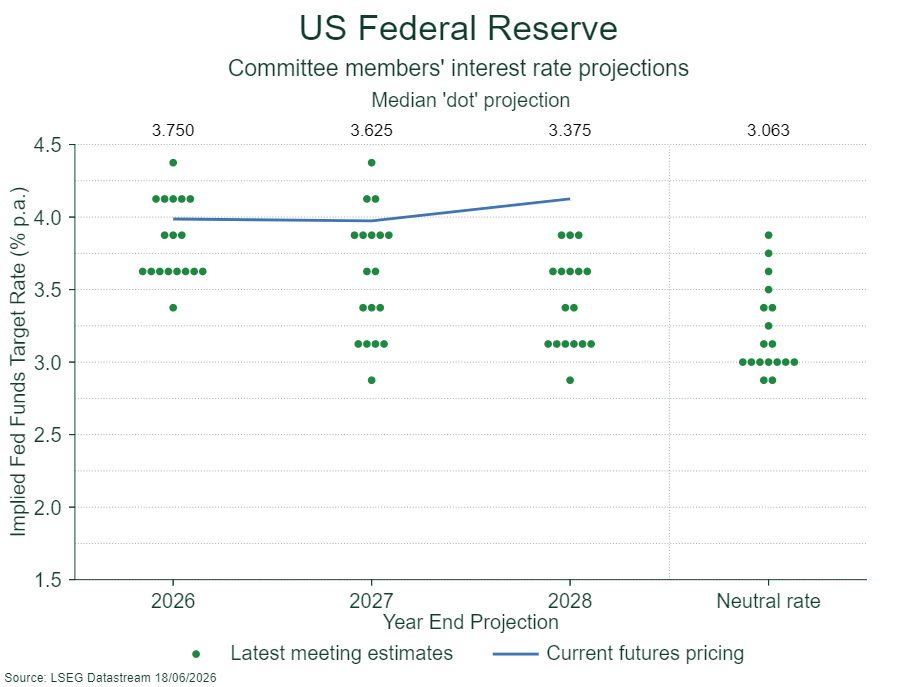
For financial markets, this transition toward intentional ambiguity is likely to be a significant change. The implications for global markets are profound, with many predicting the end of the so-called “Greenspan put”, where markets operated under the assumption that the Fed would intervene (effectively providing a put option or guaranteed price floor) to cushion against sharp asset price declines, potentially fostering moral hazard. Warsh intends to reduce the Fed’s footprint and allow markets to function without a perceived safety net. Market participants are bracing for structurally higher volatility as the central bank retreats from its role as an active manager of investor expectations.
The stylistic return to the past is rooted in a shared philosophy. Both Warsh and Greenspan have viewed asset prices as critical indicators that must be considered when evaluating the economic and financial outcomes of monetary policy. While Greenspan famously utilised a calculatedly vague speaking style, known as Fedspeak, to maintain policy flexibility and prevent market volatility, he also eventually introduced historic transparency reforms.
Without the safety net of clear guidance and the ability to step into to help with financial stability in times of market stress, traders anticipate larger price swings in bonds, equities and currencies, particularly around Fed interest rate decisions. Some analysts warn that the US Treasury’s borrowing costs could rise as investors demand higher bond yields to compensate for increased volatility and uncertainty, but other analysts argue that the ultimate goal is a more resilient financial system where the Fed acts as a disciplined guardian of the value of the US Dollar rather than the primary driver of asset prices.
The parallels between the current market environment and Greenspan’s 1990s are striking, particularly as the artificial intelligence (AI) revolution mirrors the early days of the internet boom. Just as Greenspan famously warned of irrational exuberance in 1996, the current valuation of the US equity market and heavy investment in AI suggests a level of optimism that rivals the peak of the dot com bubble. However, unlike Greenspan, Warsh views rapidly rising asset prices as a direct signal of overly easy monetary policy rather than just a potential precursor to broader inflation. He has already established a task force to study the impact of AI on productivity and disinflation, seeking to understand if this technological boom can deliver the same non-inflationary growth seen during the Greenspan era in the 1990s and early 2000s.
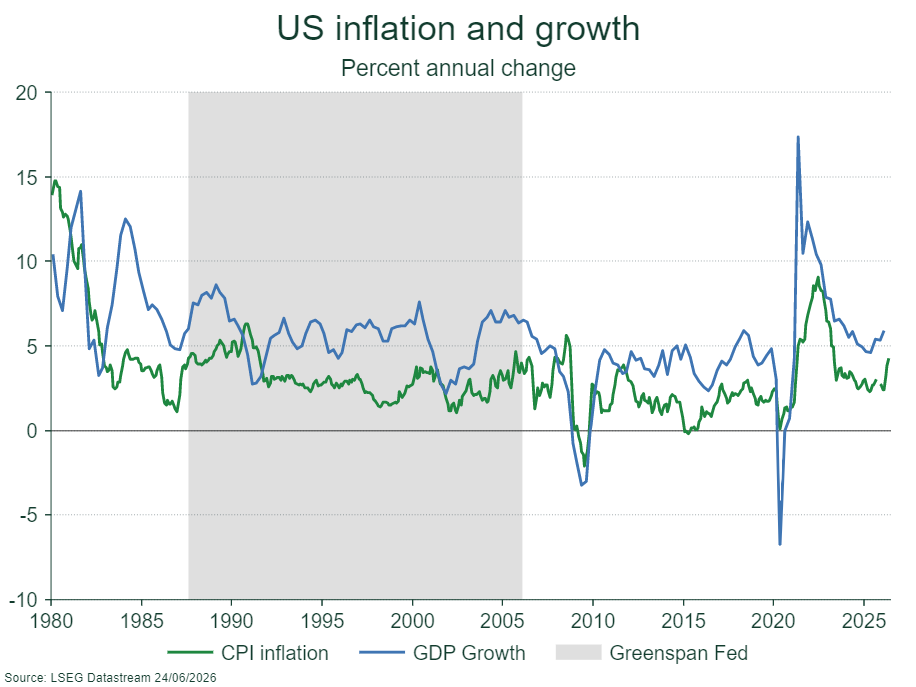
Ultimately, the Warsh era looks set to be defined by a return to central bank orthodoxy and a rejection of the emergency-style policies that persisted long after the 2008 global financial crisis. By prioritising inflation credibility and shrinking a bloated Fed balance sheet, the new chair is signalling that the Fed will no longer attempt to smooth out every market fluctuation. As he begins his tenure, the challenge for the Kevin Warsh will be to balance this return to institutional discipline with the realities of a modern financial system that has become accustomed to the Fed as an active market participant. Whether this shift successfully restores the credibility of the Fed, or merely introduces unnecessary instability, remains the defining question of the early Warsh era.
By Nick Ryder, Chief Investment Officer
Anthropic Disables Fable 5 and Mythos 5 After US Foreign-National Access Ban
Anthropic has disabled access to two of its most advanced artificial intelligence models, Claude Fable 5 and Claude Mythos 5, after the US government ordered the company to suspend access by foreign nationals, whether inside or outside the United States, including Anthropic’s own foreign-national employees.
The directive came from Commerce Secretary Howard Lutnick in a letter to CEO Dario Amodei, a copy of which was obtained by Reuters. It cited national-security authorities and required a licence for the export or transfer of the models to foreign nationals. Reuters reported that US officials feared the models could be diverted to foreign military or intelligence uses, including by China and Russia. Anthropic said the practical effect of the order was that it had to disable both models for all customers to ensure compliance. Access to its other models was not affected.
Fable 5 had launched three days before the ban as the general-use version of Anthropic’s Mythos-class technology, sharing the same underlying model as Mythos 5 but with additional safeguards applied around sensitive cybersecurity and biotechnology capabilities. Mythos 5 was not broadly available to the public and had been made available through a restricted-access programme known as Project Glasswing. Anthropic said it had worked with government agencies to test Fable 5 before launch and had received no prior warning that the model posed a national-security concern.
The company said it was later told the government believed a method existed to bypass Fable 5’s safeguards, but disputed the breadth of the concern, describing the issue as narrow and non-universal, and arguing that similar techniques could be applied to other publicly available models that were not subject to the same restrictions.
Administration officials disputed Anthropic’s account. CNBC reported that Amazon CEO Andy Jassy was among technology executives who raised concerns to senior Trump administration officials about security risks in the models. David Sacks, co-chair of the President’s Council of Advisers on Science and Technology, said publicly that Anthropic had been given an opportunity to address the vulnerability before the directive was issued and had declined. Anthropic has not confirmed that account. More than 80 cybersecurity executives and experts subsequently signed an open letter urging the Commerce Department to lift the restrictions, arguing the available evidence did not justify the scope of the order.
Senior Anthropic staff have been in meetings with Commerce Department officials in Washington in an effort to resolve the dispute, with National Cyber Director Sean Cairncross among those involved, according to Reuters. No deal has been announced and no restoration date has been set. Reuters, citing Bloomberg, reported that some early users of Mythos Preview, including selected cybersecurity organisations, retained access after the order, while other potential users were told access would no longer be available.
The order has prompted concern among US allies. At the G7 summit in Evian-les-Bains, French President Emmanuel Macron criticised restrictions that applied to allied nations and said limits on access could damage confidence in US technology. G7 leaders also discussed a possible trusted-partners scheme that could broaden access to advanced AI models for allied countries and companies.
Reuters reported that European firms including Siemens, Renault Group and Orange were reassessing their reliance on US AI providers following the restrictions. The episode has also added to existing calls across Europe for greater technological sovereignty and reduced dependence on US-controlled AI infrastructure.
The order extends US AI export controls beyond restrictions that had previously focused mainly on chips and semiconductor equipment, applying them directly to access to deployed frontier AI models. It also follows earlier tensions between Anthropic and the Trump administration over proposed military uses of AI, including domestic surveillance and fully autonomous weapons systems.
As of 23 June, Fable 5 and Mythos 5 remained restricted and Anthropic had not announced when access would be restored.
Sources
Anthropic (2026), Fable/Mythos suspension
Anthropic (2026), Fable/Mythos launch
Reuters (2026), US export curbs concerns
Reuters (2026), Export curbs talks
CNBC (2026), Mythos dispute meeting
By Joey Mouracadeh, Senior Investment Director
ASIC Puts Private Credit Funds on Notice Ahead of 30 June Valuations
Australia’s corporate regulator has warned private credit funds to ensure their 30 June asset valuations are current, accurate and based on realistic assumptions, as signs of credit stress begin to emerge across parts of th sector.
In a notice published on 18 June, ASIC called on boards, auditors, responsible entities, trustees and chief investment officers to assess their practices against its private credit principles and improve standards where needed. The sector, the regulator said, was facing its first real test after a period of rapid growth, with tighter liquidity, emerging borrower stress and early signs of credit deterioration now testing valuations, governance and investor disclosures across the market.
The warning followed an eight-week voluntary survey conducted from 26 March to 14 May, covering 22 private credit managers across 52 funds and approximately $76 billion in assets under management. Early findings pointed to uneven credit deterioration, including pockets of higher defaults, impairments and loan amendments, alongside tightening liquidity buffers, softer investor inflows and variable management of concentration risk. In property development specifically, cost escalation, project delays, soft presales and weaker refinancing conditions were identified as putting pressure on borrowers in ways not yet reflected in reported valuations.
On valuations, the regulator was direct: funds should not wait for formal defaults before reassessing asset values, and those that do not reflect current conditions increase the risk of misinformation and poor investor outcomes. Obligations across the funds-management chain, from origination through to audit, cannot be outsourced.
The June notice forms part of ASIC’s broader scrutiny of private markets, which has been building since the release of REP 814, Private Credit in Australia, in September 2025 and REP 820, Private Credit Surveillance: Retail and Wholesale Funds, in November 2025. The latter identified gaps in governance, valuation, disclosure and conflicts management. A catalogue of legal obligations for fund operators has since been published, with regulatory guidance updates planned for 2026-27.
Poor private credit practices are among ASIC’s stated enforcement priorities for 2026. Active surveillances across wholesale and retail funds are well progressed and multiple enforcement investigations are underway. In 2025 the regulator issued stop orders against TruePillars Investment Trust, RELI Capital Mortgage and La Trobe Australian Credit Fund over disclosure concerns. ASIC Chair Sarah Court has said the regulator would not hesitate to take enforcement action where conduct falls short, and surveillance will continue as funds finalise their 30 June valuations and reporting.
Sources:
ASIC (2026), Private Credit Notice (30 June valuations)
Reuters (2026), ASIC calls to refresh valuations
Broker Daily (2026), ASIC flags private credit risks
ASIC (2025), REP 820: Private Credit Surveillance
ASIC (2025), REP 814: Private Credit in Australia
Hall & Wilcox (2026), ASIC enforcement priorities (private credit)
By Joey Mouracadeh, Senior Investment Director
Testing the Test
The Australian government is navigating a critical juncture in the evolution of its superannuation system, as Treasurer Jim Chalmers prepares to consult on potentially significant reforms to the annual Your Future, Your Super (YFYS) performance test for superannuation funds. The performance test, administered by the Australian Prudential Regulation Authority (APRA), was originally designed to protect retirement savings by weeding out persistent underperforming superannuation funds, but industry participants increasingly argue that the cure may be more damaging than the disease.
Each year the YFYS performance test compares a fund’s ten-year net investment returns against a blended benchmark made up of market indices that includes the S&P/ASX 300 Total Return Index for funds that invest in Australian shares. While the test has successfully removed many subpar superannuation products, it has also institutionalised a practice known as “benchmark hugging”. Superannuation fund trustees, fearing the existential threat of test failure, which can lead to a fund’s closure, have increasingly aligned their portfolios to mimic market indices rather than seeking to maximise long term returns for members.
Since the test was introduced, the number of APRA-regulated funds has plummeted. In June 2021, there were 158 funds but by late 2025, that number had dropped to just 89. This consolidation was heavily influenced by the existential threat posed by the performance test. For example, 13 of the 14 funds that failed the very first test in 2021 have since closed, and in most cases, their parent funds have also disappeared through mergers with larger, better performing funds. As funds have grown significantly larger, they have faced new challenges that further influence behaviour, including capacity constraints that make it harder for huge superannuation funds to allocate billions of dollars to active fund managers without moving the market, strengthening the case in favour of passive investing.
This behavioural shift has created what critics call an index trap on the Australian Securities Exchange (ASX), leading to an extraordinary and possibly dangerous concentration of capital in the largest ten ASX-listed companies. Current data suggests that approximately fifty cents of every dollar invested by superannuation funds in domestic shares is being funnelled into just ten stocks, predominantly the major banks and miners. The resulting price insensitive capital flows have driven the valuations of these top stocks far beyond their underlying earnings fundamentals, creating a market where price momentum (i.e. buying stocks that have been rising and selling stocks that are falling) rules over making investment decisions based on fundamentals such as underlying earnings growth, valuations and business quality.
While the ten largest companies have significantly outperformed the rest of the market over the last decade, their earnings growth has remained broadly similar to the other 290 stocks in the S&P/ASX 300 index. This top-heavy market structure has reduced liquidity and demand for smaller companies, making it harder for new companies to list on the ASX and increasing single stock volatility during reporting seasons, where the absence of fundamental buyers leads to violent price swings as fewer and fewer investors scrutinise the company’s performance.
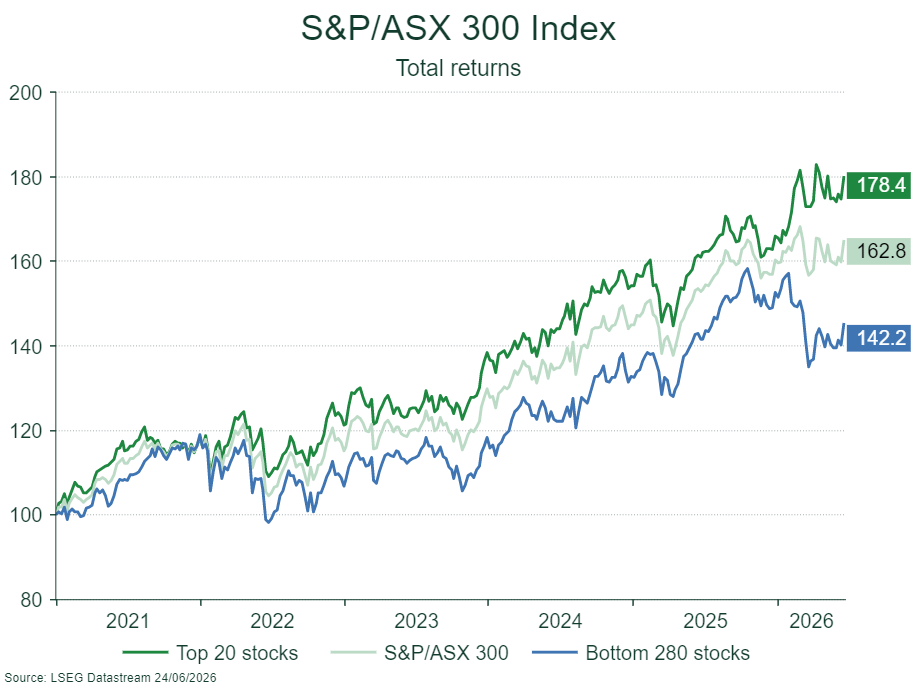
For active fund managers, this environment has become increasingly hostile as they find it nearly impossible to outperform benchmarks driven by momentum and forced index replication. Many experienced stockpickers have struggled to beat the index over short- and medium-term time horizons, leading their clients to withdraw capital and recycle it into passive funds, further reinforcing the index concentration trade and leading to the closure of many actively managed funds. Observers warn that the decline of active management also reduces the oversight of corporate boards and management teams, potentially weakening the governance and vibrancy of the entire Australian economy. It also makes it harder for start-ups and fast-growing smaller companies to raise capital locally which has longer term economic impacts on productivity, job creation, and dynamism.
The Treasury is now looking to address these concerns by examining how the performance test can remain fit for purpose as the system evolves. Central to the government’s current proposals is the potential to carve out certain asset classes from the annual performance test, such as venture capital, renewable energy, and affordable housing. These assets are often avoided by the major superannuation funds under the current rules because their short-term volatility could trigger a performance test failure, even if they offer strong long-term value for fund members. The intention behind this move is to unlock a greater portion of the superannuation industry’s vast capital for nation-building projects and investments that traditionally carry more risk and require longer-term time frames.
Other reform options include shifting the test toward a risk-adjusted return model using a simple reference portfolio to measure the actual value delivered for the level of volatility taken. There are also calls to expand the test to cover a broader range of superannuation products, as millions of Australians currently remain outside these performance protections through superannuation products sitting on investment choice platforms. While the government remains committed to the principle of accountability, it is under intense pressure to ensure the test does not continue to distort capital allocation or limit national productivity. As the consultation period concludes this month, the Australian retirement sector remains watchful of whether there are any changes to the test and how they can restore market dynamism without compromising the safety of superfund members’ financial interests.
By Nick Ryder, Chief Investment Officer
The AI Capital Surge Reshaping Private Markets
An unprecedented wave of private capital is reshaping the global artificial intelligence landscape, with investment flows accelerating to historic levels. In the first quarter of 2026 alone, venture capital funding into AI companies reached a staggering US$255 billion, narrowly surpassing the US$254 billion deployed across the entirety of 2025. Interestingly, rather than a broad based expansion across thousands of early-stage startups, the surge has been highly concentrated. Institutional investors and major technology corporations are deploying billions of dollars into a narrow cohort of perceived market leaders, in an attempt to back, what they believe will be the dominant platforms of the future.
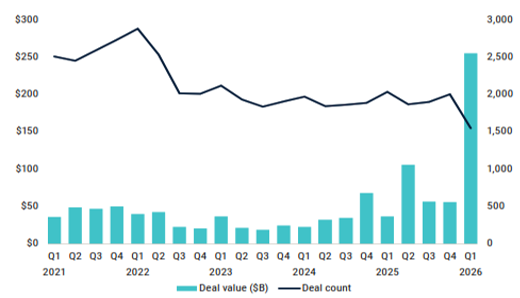
At the centre of this, are foundational AI companies developing large scale, general purpose models. This segment alone absorbed approximately US$197 billion across nearly 400 transactions in the first quarter of 2026, underscoring the scale and intensity of capital competition at the top end of the market. Throughout 2026, there have been three landmark funding rounds that have dominated news headlines. The first being, OpenAI which secured a record breaking US$122 billion capital raise, supported by a consortium including Amazon, Andreessen Horowitz, NVIDIA and SoftBank. Anthropic also managed to raise US$30 billion from leading investors such as Coatue, Founders Fund and MGX. Meanwhile, Elon Musk’s xAI attracted US$20 billion in fresh funding, with significant backing from NVIDIA and Valor Equity Partners. The sector also witnessed one of the largest private market corporate transactions in history, with Musk’s SpaceX acquiring xAI in a US$250 billion deal ahead of its highly anticipated IPO in early June.
Despite this strong momentum, it is important to remain aware of persistent macroeconomic risks. Elevated geopolitical tensions, including further potential disruptions to critical global trade corridors such as the Strait of Hormuz, have placed upward pressure on energy prices and revived concerns over inflationary persistence. Although these factors are not expected to materially impede the structural growth of the artificial intelligence sector, a prolonged period of higher interest rates may serve as a moderating influence. In particular, tighter financial conditions could slow the cadence of public market listings and restrain further expansion in already elevated valuations across the technology landscape.
Market participants are also increasingly becoming mindful of the risks associated with accessing these private market companies. In order to gain exposure, investors will have to deploy capital in illiquid investment vehicles, which typically have a long term lock-up (i.e.10+ years), or may offer periodic redemption windows, which can be suspended at any time (particularly during periods of high market stress), with little to no notice. These factors and more, were carefully assessed during Stanford Brown’s most recent private equity sector review which was conducted by the investment team in the second half of 2025. Various new additions were made to the private equity investment menu. Weary of the hype and over-investment in early-stage AI companies these new options tend to invest in more mature, cash-generating businesses with stable earnings growth, diversified by sector, ensuring that clients are not becoming overly exposed to any one theme or risk.
By Joseph Nakhoul, Investment Research Analyst
Britain’s Revolving Door at Number 10
Britain is preparing to install its seventh Prime Minister since the 2016 Brexit referendum. Such rapid leadership turnover would once have been almost unthinkable in Westminster. While the United Kingdom no longer exerts the global economic influence it once did, it still provides an important lesson for investors. Markets are remarkably tolerant of political change, but they are far less forgiving of prolonged policy uncertainty.
Frequent changes at the top create uncertainty around the economic settings that businesses and investors rely upon. When governments repeatedly revisit tax policy, regulation and fiscal priorities, the planning horizon shortens. Businesses become more cautious about committing capital, households defer major financial decisions, and investors demand a higher return to compensate for increased uncertainty. Politics provides the headlines, but the real economic story is whether governments continue to provide a stable, credible and predictable policy framework that allows capital to be deployed with confidence.
Britain offered a sharp reminder of this in 2022. The short lived “Mini Budget” under Liz Truss proposed large, unfunded tax cuts without a credible plan to finance them. Markets were not reacting to the political philosophy behind the measures, they were responding to concerns about fiscal sustainability. Confidence in Britain’s public finances deteriorated rapidly. Government borrowing costs surged, sterling weakened, pension funds came under pressure, and the Bank of England was forced to intervene to restore stability. The episode lasted only weeks, but the lesson was enduring. Financial markets can price almost any policy, provided it is credible and predictable. What they struggle to price is uncertainty itself.
That is the deeper risk of frequent leadership turnover. It is not any individual Prime Minister that matters most, but the cumulative effect of instability, policy reversals, abandoned reforms, and a diminishing confidence that long standing commitments will be honoured. Economies thrive on predictability. When governments change frequently, that predictability is often the first casualty, and the consequences emerge gradually through weaker business investment. Australians have experienced a milder version of this dynamic. Between 2010 and 2018, Australia cycled through six prime ministerships in eight years as both major parties replaced sitting leaders mid term. While the economy remained resilient, policy consistency suffered. Energy policy provides perhaps the clearest example. The introduction and subsequent repeal of the carbon pricing mechanism, followed by years of shifting climate and energy policy, created uncertainty that discouraged investment across parts of the energy sector. Businesses ultimately adapted, but the experience demonstrated that even strong economies benefit from political continuity when tackling structural challenges. Leadership instability is certainly not uniquely British, but an increasingly common feature of modern parliamentary democracies.
As Britain prepares for another change in leadership, much of the political attention has centred on Andy Burnham, who is widely expected to become the country’s next Prime Minister. From an investment perspective, however, the more important question is not who occupies Downing Street, but whether his government can restore confidence in fiscal discipline, provide a consistent policy framework, and create conditions that encourage business investment and productivity growth. Those are the signals that ultimately influence borrowing costs, corporate profitability, and investment returns. For Australian investors building globally diversified portfolios, the message is measured. History suggests investors remain focused on the enduring drivers of returns, economic growth, inflation, interest rates, corporate earnings and fiscal sustainability, while recognising that much of the day-to-day political narrative is simply noise. Perhaps we would all benefit from a bit less noise!
By Vincent O’Neill, CEO