


SB News - November 2026
Anthropic Files for IPO, Disclosing Rapid Revenue Growth and Substantial Infrastructure Commitments
Anthropic has revealed a sharp acceleration in revenue alongside hundreds of billions of dollars in future computing commitments, as the artificial intelligence developer prepares for one of the largest stock market listings on record. The figures were disclosed in a public IPO filing submitted to US regulators on 26 October, ahead of an expected Nasdaq debut in November under the ticker ANT.
The filing shows how quickly Anthropic’s commercial business has expanded. The company took in $4.6 billion across the whole of 2025. In the first six months of 2026 alone it recorded $16.3 billion, with an annualised run rate of approximately $65 billion by July as momentum continued to build. Around 80% of that revenue is consumption-based — enterprises and developers paying directly to use Claude — a structure that ties income closely to the volume of AI workloads being run through the platform.
The net loss of $80.7 billion for the first half of 2026 is the number most likely to dominate initial coverage, but it is largely a product of accounting rather than operations. Of that figure, $72.4 billion reflected adjustments to the fair value of convertible notes and related financial instruments — non-cash charges that move with the company’s rising private valuation rather than its day-to-day spending. The company’s operating loss, which excludes those valuation adjustments, narrowed to $693 million from $2.1 billion a year earlier, as the revenue base expanded faster than costs.
The scale of the computing infrastructure required to support that growth is equally striking. The filing discloses approximately $542 billion in future data centre and cloud computing obligations, under contracts extending as far as 20 years, up from the $518 billion reported in September. One arrangement calls for Anthropic to pay SpaceX approximately $3.1 billion per month for Nvidia-powered computing capacity, once all contracted resources have been delivered under agreements that began in May 2026. Twenty-two banks are underwriting the offering, led by Goldman Sachs and Morgan Stanley.
Reports ahead of the filing suggested a valuation of between $1.5 trillion and $2 trillion, although the S-1 contains no proposed offer price. The filing describes a governance structure under which the founders retain majority voting control alongside separate board oversight arrangements linked to the company’s public-benefit objectives. Rival OpenAI has indicated its own listing will not happen before 2027. Anthropic is expected to begin trading in November, subject to SEC review.
**Sources:** SEC EDGAR, Form S-1 (accession 0001628280-26-067168, 26 October 2026); Reuters; CNBC; Financial Times; NPR; Axios
By Joey Mouracadeh, Senior Investment Director
Running Hot
The Australian economic landscape has entered a more challenging phase as the Reserve Bank of Australia (RBA) confronts rising unemployment and hotter-than-expected inflation. The latest set of inflation data released this week has dashed expectations that the RBA would keep rates on hold for an extended period, with markets and major lenders now pricing in a high likelihood of an interest rate hike when the central bank meets next week.
The Australian Bureau of Statistics confirmed that quarterly trimmed mean inflation, the RBA’s preferred measure of underlying price growth, printed at 1.0% for the September quarter, pushing the annual rate to 3.7%. This was materially above the RBA’s 2-3% target range and the RBA’s August forecasts of 3.4%. In the same report, the monthly measure of headline inflation climbed to 4.3% year-on-year in September, driven heavily by a 9.4% monthly surge in petrol prices.
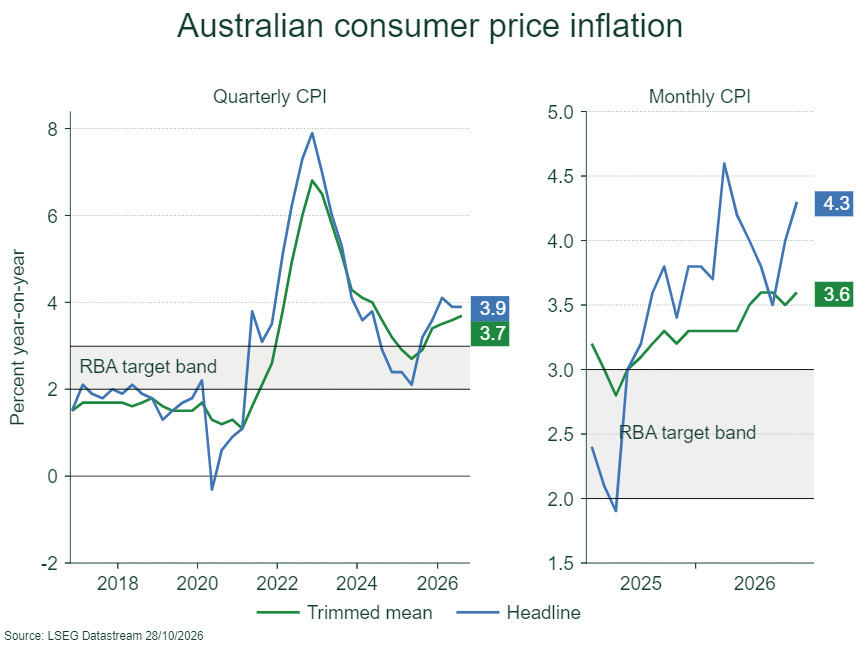
Domestic capacity pressures and global cost-push inflation continue to drive consumer prices higher. Annual services inflation accelerated to 4.1% in September, its highest level since late 2025, reflecting persistent strength in everyday expenses such as restaurant meals, vehicle servicing, and veterinary costs. Meanwhile, housing costs remain a stubborn driver of elevated inflation, with ongoing supply constraints keeping rent growth and construction costs high.
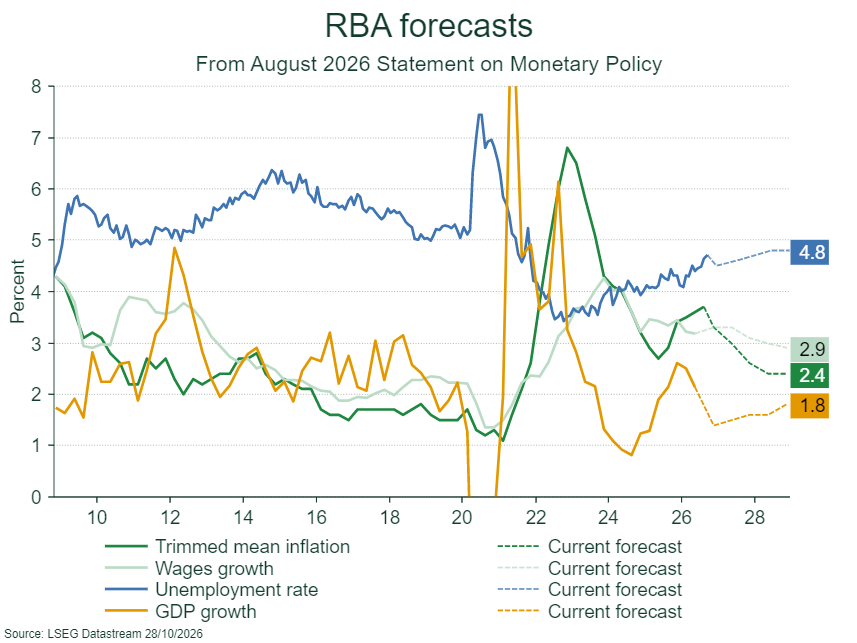
RBA Governor Michele Bullock and Deputy Governor Andrew Hauser have signalled a distinct shift in tone in recent weeks, pointing out that several international and domestic upside risks have materialised. Governor Bullock noted that the labour market appears slightly tighter than previously anticipated, with elevated underlying price pressures reflecting an economy running up against supply-side constraints. This is despite the fact that the unemployment rate has risen from 4.1% to 4.7% so far in 2026, also above the RBA’s August forecast.
Compounding the impact of supply constraints, prolonged geopolitical conflicts continue to keep global oil and refined fuel product prices high, adding direct and indirect costs to local supply chains. Also complicating the inflation outlook is the removal of credit card surcharges in October, which will likely see businesses lift prices in coming months to pass on the costs of accepting credit cards to all customers.
The combination of sticky underlying inflation and persistent structural pressures has forced a rapid repricing of interest rate expectations. Structural inflationary pressures include weak labour productivity growth, high government spending and massive investment in AI infrastructure, data centres, and renewable energy projects, all of which are longer term in nature and less sensitive to higher interest rates. These structural drivers of inflation are offsetting shorter term cyclical forces that should be helping to lower inflation, including four rate rises this year, rising unemployment, falling property prices and weak consumer sentiment.
Following the inflation data release, financial markets have increased the chances of a rate hike in November to around 90%, and major lenders have adjusted their interest rate outlooks, with several forecasting a 25-basis point rate rise on Melbourne Cup Day to safeguard against inflation expectations drifting higher. Whether the RBA chooses to act decisively next week as an insurance move or opts to balance cooling cyclical indicators against structural headwinds, the upcoming policy decision remains finely balanced and the decision by the RBA Board may not be unanimous. We will find out next Tuesday.
By Nick Ryder, Chief Investment Officer
Money Never Sleeps
Starting on 6th December, US equity markets are moving to what is loosely termed as “24-hour trading” across five major stock exchanges, including Nasdaq and NYSE Arca. However, the upcoming shift is not a continuous 24/7 trading free-for-all. Instead, it is a 23×5 model: trading will run from 9:00pm (US Eastern Standard Time) on Sundays through to 8:00pm on Fridays with a mandatory one-hour operational trading pause at 8:00 – 9:00pm on Monday through Thursday.
Why are US stock exchanges rushing to embrace the nocturnal shift? It’s partly due to the competition for investor attention with other continuously traded assets, such cryptocurrencies, prediction markets and futures, as well as demand from investors based outside the US in other time zones. As former SEC commissioner Hester Peirce noted before leaving the agency, international investors, such as South Korean retail investors, are hungry for the ability to trade US-listed AI stocks around the clock and don’t want to wait for the US market to open.
Another reason for the move to extend the official trading hours is that Alternative Trading Systems (ATSs) like those run by Blue Ocean and brokerages, such as Robinhood, have already captured steady volume in after-hours trading. These ATSs aim to allow retail investors with fulltime day jobs the ability to trade after work. Concerns about equity market liquidity drifting from official stock exchanges into ATSs, stock exchange operators such as NASDAQ decided they had to try to bring the after-hours party in-house.
The timing of this push to extend trading hours is especially fascinating when viewed through the lens of academic research which has identified something referred to as the ‘Overnight Return Anomaly’.
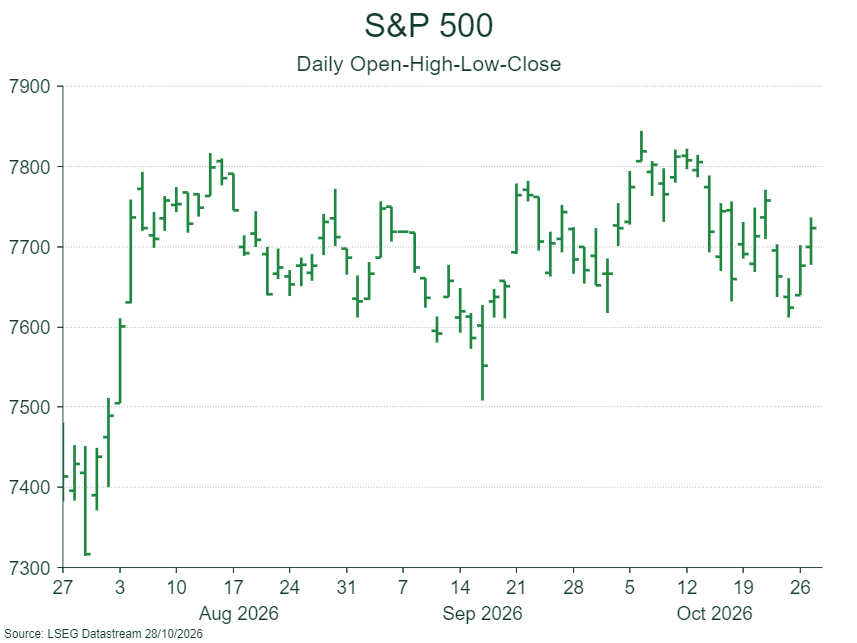
For decades, conventional wisdom held that most price discovery between buyers and sellers of stocks happens mainly when the market’s opening bell rings at 9:30am. Yet extensive historical research, including long-term studies by the Federal Reserve Bank of New York, contradicts that narrative. Over decades, virtually all the cumulative gains in major indices like the S&P 500 occur between the 4:00pm close and the next morning’s 9.30am open, while regular daytime sessions have historically produced flat or negative returns.
Reasons that positive returns may only be generated overnight is driven by information clustering (for example company earnings reports and macroeconomic data is often released outside regular market hours), the resolution of global asset price uncertainty during European market hours, and the illiquidity premium that brokers and market makers demand for holding inventories of stocks overnight rather than closing out positions at the end of the day as most day traders do.
Up until now, transaction costs, wide bid-ask spreads, and execution friction have kept retail investors from exploiting the Overnight Return Anomaly. But as formal 23×5 exchanges deepen liquidity and narrow those spreads, hedge funds and other investors will actively compete to capture overnight returns.
Despite the allure of potentially higher returns, current overnight trading volumes remain modest. Even though overnight volumes surged 358% year-over-year in late 2026, they only account for a tiny 0.1% of regular trading hours volume, and with nine of the top ten most traded nocturnal stocks being small, under-researched companies with share prices of less than $1, commonly referred to as “penny-stocks”.
Yet, as trading in larger companies and exchange traded funds join the fold once exchanges such as NASDAQ provide overnight trading, the risks for retail share traders could intensify:
- Wild Price Swings: Graveyard-shift investor participation is low, creating a fertile breeding ground for large share price swings and spikes in volatility, particularly around social media posts and other news flow.
- Market Manipulation: Former enforcement officials warn that low overnight liquidity entices bad actors. As Georgetown professor James Angel notes, retail investors stumbling into the equity market at 2:00am face risks of price manipulation and spoofing (fake bids and offers for shares which then disappear when investors attempt to transact) by automated trading bots.
- Regulatory Blind Spots: The SEC is implementing extended market hours while facing staffing shortages and without providing any standardised risk-management guidance for brokers which limits the ability of brokers and regulators to monitor markets for compliance and detect illegal activity.
Bloomberg columnist Matt Levine has somewhat tongue-in-cheek argued that equity market trading should actually be compressed into a 15- or 30-minute window each day so liquidity is highly concentrated in a short time frame. He suggests overnight trading makes markets less efficient by spreading liquidity thinly, ruining work-life balance for financial workers and forcing companies to deal with impulsive, knee-jerk stock reactions to news or social media rumours late at night when no one is awake to provide orderly pricing or dispel such rumours.
On paper the move to 23×5 trading looks like a win for international access to US equity markets. However, it introduces operational complexity, heightened market manipulation risks, and a host of headaches for executives of listed companies, regulators and financial services companies. While round-the-clock share trading may potentially benefit online brokers and level the playing field with markets that allow continuous trading such as cryptocurrencies, foreign exchange and predictions markets, the question remains: what real economic benefit does a longer trading day deliver.
By Nick Ryder, Chief Investment Officer
Private Credit Takes Flight
Private credit has faced heightened scrutiny over the past 12 to 18 months, as questions around borrower stress, valuation transparency and liquidity have raised broader concerns around risk across the asset class. Both global and domestic private credit managers have been affected, with some being heavily scrutinised within the media over their valuation methods and others having to subsequently limit withdrawals available to investors. As a result, attention is increasingly shifting beyond corporate direct lending and real estate debt, towards the rapidly growing asset-backed finance (ABF) market. Rather than primarily lending against a company’s earnings and enterprise value or the prospect of a real estate development, managers instead finance pools of identifiable assets, and the cash flows they generate. These can range from consumer receivables to equipment, artwork, infrastructure and aircrafts.
Aviation financing stands out as a compelling opportunity within ABF, supported by a combination of structural capital demand and favourable underlying asset dynamics. An estimated 19,000 to 21,000 new aircrafts could require financing globally over the coming decade, while constrained aircraft supply, engine and spare parts bottlenecks, and demand for newer, fuel-efficient fleets continue to support underlying aircraft values and leasing rates. With the market expected to grow materially towards the end of the decade, this creates an attractive environment for lenders to provide capital against scarce, income-generating assets with established secondary markets. Importantly, aviation finance allows lenders to underwrite both the creditworthiness of the borrower (airline) and the value of the underlying aircraft, providing a differentiated source of credit exposure.
Should an airline experience financial stress, the lender is not solely reliant on the financial strength of that one specific borrower for recovery. The aircraft itself provides an additional layer of downside protection, particularly in an environment where aircrafts remain scarce and in demand. Recovery can therefore be supported by the value and condition of the aircraft, and, importantly, the ability to repossess, remarket and redeploy the asset to another airline, which is not proving to be a challenge at this point in time.
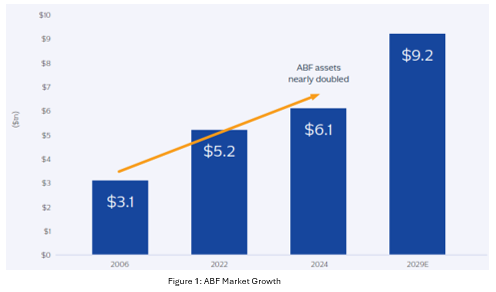
The rapid growth of ABF highlights why private credit should be viewed as far more than corporate direct lending or real estate debt. While recent scrutiny has largely been focused on these areas of private credit, the broader private credit universe offers exposure to a diverse range of borrowers, assets, and cash flows. The ABF market itself has nearly doubled from around US$3 trillion in 2006 to US$6 trillion in 2024 and is estimated to approach US$10 trillion by the end of the decade. This highlights the scale of this expanding opportunity set, reinforcing the value of partnering with flexible private credit managers that can allocate across ABF markets and more traditional private credit markets, as opportunities evolve. It is important to note that while ABF offers a differentiated source of exposure, it remains subject to the inherent liquidity constraints of private markets, including the potential for fund lockups.
By Joseph Nakhoul, Investment Research Analyst
PHP2Shell and the new pace of cyber risk
A website goes offline. A file upload stops working. An online service becomes unavailable. Behind these inconveniences, technology teams may be racing to close a door that attackers have already started testing.
That happened in October when two critical vulnerabilities were disclosed in PHP, a programming language underpinning many websites and online services. Known as PHP2Shell, the flaws could let attackers execute code on vulnerable servers without logging in. Emergency fixes were released on 21 October (early on 22 October, Sydney time).
In Australia and overseas, some service providers and website operators restricted functionality or temporarily took services offline as a precaution. The significance extends beyond interrupted websites. PHP2Shell illustrates how artificial intelligence is changing the economics of cyber risk, making weaknesses easier to investigate while putting greater pressure on the people responsible for repairing them.
Old weaknesses, new capabilities
The vulnerabilities affect PHP versions dating back to PHP 5.4, released in 2012. Researchers using AI helped establish how the vulnerabilities could be exploited, giving defenders valuable information to prepare fixes and protections. This is an important benefit. Discovering a weakness creates an opportunity to close it before damage occurs, and AI can compress investigative work that would otherwise absorb considerable time. But defenders were not necessarily first to the door. Amazon reported detecting an exploitation attempt against its monitoring infrastructure on 17 October, four days before public disclosure, and broader exploitation attempts once details became public.
We should distinguish what is known from what is possible. AI helped investigate these vulnerabilities. That does not prove AI drove the early attack attempt. The broader concern is that tools accelerating defensive research can also accelerate offensive work. For businesses, this changes the calculation. Exposure can arise simply from using the same software as millions of others. Being small, obscure or seemingly uninteresting offers little comfort when a single weakness can be pursued across many targets.
The Patchmageddon problem
J.P. Morgan’s Michael Cembalest examined this imbalance in his July report, Patchmageddon. He highlighted how the interval between disclosure and exploitation had effectively collapsed, while organisations struggled to install repairs. In roughly 60% of breaches, he reported, a patch was already available when the compromise occurred. That statistic matters. Finding a solution and implementing it are different achievements.
Businesses must identify affected systems, test updates, coordinate suppliers and manage disruption. A repair that works in isolation may interact badly with another critical application. Older systems may be difficult to update at all. The PHP Foundation acknowledged that early signs of one underlying problem emerged in 2024. Limited specialist resources, difficult technical trade-offs and the project’s decision-making process contributed to delays.
There is an economic issue here too. Widely used software can support substantial commercial activity while depending on relatively small teams for maintenance. The benefits are distributed across thousands of organisations, while responsibility for difficult repairs can sit with very few people. While AI can accelerate discovery, organisational bottlenecks remain stubbornly human.
Our view is that we have entered a new norm. Cyber preparedness must assume that the time available to respond may be shorter than established processes allow.
What this means for investors & individuals
Cyber resilience increasingly belongs alongside balance sheet strength and management quality when assessing a business. A profitable company can still be operationally fragile if core systems depend on poorly maintained software or a small number of suppliers. Familiar brands and substantial technology budgets do not, by themselves, demonstrate preparedness.
The financial consequences can extend well beyond the immediate outage. Recovery expenses, lost customers, legal obligations and damaged trust can affect earnings long after systems return.
We also argue for care when considering cybersecurity itself as an investment opportunity. Growing demand does not automatically make every provider attractive. Competitive advantage, sustainable earnings and valuation still matter.
For individuals, strong authentication, unique passwords, and prompt updates remain essential habits. So does creating room to pause before acting on an unexpected request. AI offers genuine defensive benefits. It also raises the standard of care required from everyone using digital services. Staying alert has never been more important.
Sources: PHP Foundation, security release and response; Michael Cembalest, Patchmageddon, J.P. Morgan, 22 July 2026.
By Vincent O’Neill, CEO
Latest Podcast
Data Centre Doubts, AI Risks and the RBA’s Next Move
Listen on Apple Podcasts
Watch on Youtube: