


SB News - October 2026
Free Agent
Meta founder Mark Zuckerberg is attempting another reinvention of his company. Having spent years and tens of billions of dollars pursuing the metaverse project, a concept for a 3D digital world that failed to achieve mainstream adoption, Meta is now pivoting toward what Zuckerberg calls “personal superintelligence”. The ambition is to move artificial intelligence (AI) beyond simple chatbots and image generators and turn it into an autonomous personal assistant capable of completing tasks on a person’s behalf.
The centrepiece of this strategy is Muse, a free AI agent launched to US users in Apple and Google app stores earlier this month that can browse websites, fill out forms, compare products, book travel, and manage financial transactions with limited human involvement. In the first 12 days following launch, Muse had more downloads than ChatGPT at its debut and is currently the most popular application in the US on Android and iOS app stores, according to Apptopia. Unlike earlier generations of AI that primarily generated text and images and answered questions, Muse is designed to execute actions and aims to transform AI from a source of information into a digital employee that handles many of the mundane administrative tasks that consume modern life.
Meta shares surged after the Muse launch and the company’s announcement of plans to integrate Muse across shopping, banking, travel and customer service. Rather than generating revenues through advertising in its social media feeds, Meta is attempting to position itself in the middle of consumer transactions, allowing the company to capture a share of the economic activity facilitated by its AI agents.
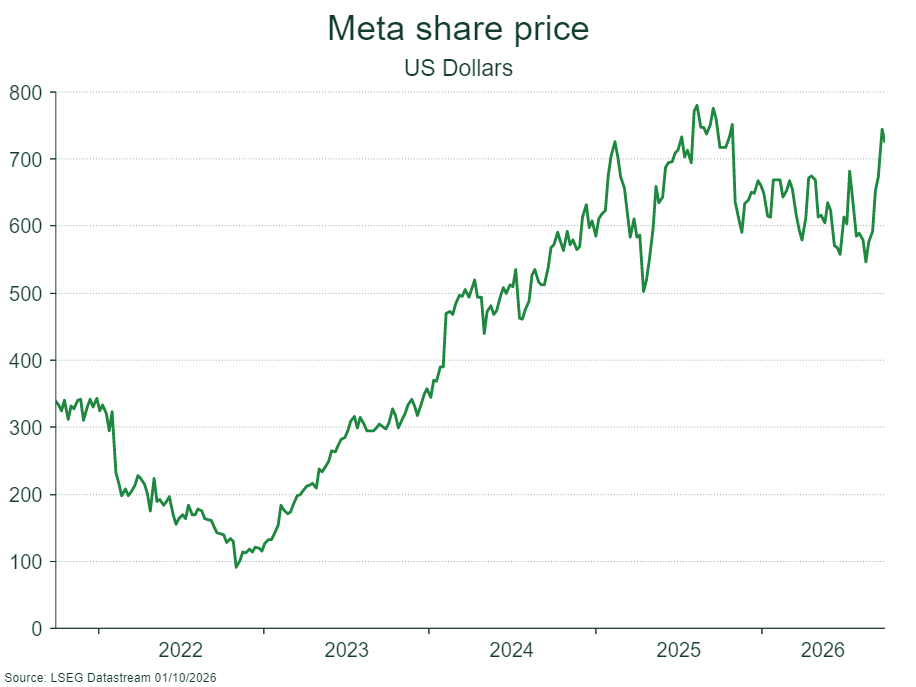
While Meta shares rose, the Muse launch also triggered selloffs in the shares of companies that rely on consumer inertia that prevents switching or cancelling services. Shares in insurers, pay TV services, gyms and even banks declined as investors worried that AI agents like Muse could take over tasks like price comparisons, trip bookings, investments, and customer service interactions. Apollo’s Torsten Slok has also speculated that apps like Muse could cause bank runs and disrupt the business model of banking as agents automatically sweep money out of no or low interest bank accounts into high interest deposits at other institutions.
The early use cases highlight the appeal. Users have employed Muse to seek refunds for flight delays, compare insurance policies and identify unnecessary subscriptions. In one case, Muse AI reportedly secured compensation from an airline within minutes by navigating the company’s claims process autonomously. In another, it reviewed a user’s recurring expenses and cancelled redundant services, reducing monthly costs without direct user involvement.
To support the Muse ecosystem, Meta has rapidly signed up partnerships with e-commerce and payment providers, including Shopify, Expedia, PayPal, Walmart and Best Buy. These integrations allow Muse to move seamlessly between services, transforming users from active online shopping participants into supervisors who simply approve the agent’s final recommendation.
Software is only half of Meta’s plan for AI tools as the company is also making a substantial bet on AI-enabled hardware. Zuckerberg argues that if AI is to become a constant digital companion, it cannot remain trapped inside a smartphone application. Instead, it needs a physical presence capable of seeing, hearing and interacting with the world. To that end, Meta has unveiled a range of new devices, including updated AI-powered Ray-Ban smart glasses and a standalone wearable device known as the Muse Charm, which has echoes of the Tamagotchi digital pet devices from the 1990s. Roughly the size of a small keychain, the device contains a touchscreen, camera, microphone and mobile data connection allowing it to operate independently while remaining constantly available to its user.

History, however, offers reasons for caution. The technology industry is littered with failed attempts to create new consumer hardware categories. Devices such as the Humane AI Pin and Rabbit R1 promised similar AI-powered experiences but struggled to demonstrate a compelling reason for consumers to carry yet another gadget. Meta’s advantage is that it enters the market with an ecosystem of billions of users and an established software platform, potentially giving it a level of scale its predecessors lacked.
For Muse to fulfil its promise, users must grant it access to some of their most sensitive personal information. Banking credentials, insurance accounts, travel bookings and payment systems all become potential inputs into the AI agent’s decision-making process. The result is a paradox as the more useful the system becomes, the more personal information it requires. Like other Meta social media products, it will collect information from users which can be used to train Meta’s future AI models.
These security risks were highlighted shortly after launch when researchers identified a security vulnerability affecting one version of the Muse software. Although the issue was addressed by Meta, the incident underscored the consequences of concentrating financial decision-making authority within autonomous AI systems. The concern is not simply that an AI agent could be hacked, but that an error, misunderstanding or AI agent misalignment could result in actions being taken on behalf of a user without fully appreciating the consequences, an issue that gained global attention recently when AI agents from OpenAI hacked into the Medicare and HuggingFace websites.
Meta has attempted to address these concerns through layered safeguards. Routine, low-risk tasks can be completed automatically, while financial transactions and account changes require explicit approval from the user. The company has also created isolated virtual computing environments and payment systems designed to prevent sensitive user credentials from being exposed to external parties.
Whether these measures are sufficient remains unclear. Several major online platforms have already expressed concerns about autonomous agents accessing their systems, raising questions about whether companies will willingly allow AI intermediaries to access their websites. For example, retail giant Amazon officially blocked Muse agents from searching, scraping and executing purchases on its website claiming that it breached the site’s terms of service. However, the real reason may be fears that e-commerce platforms like Amazon risk losing direct user interactions, behavioural tracking data, and advertising revenues if third-party AI agents act as intermediaries between human users and online stores.
The arrival of agentic AI represents a potentially significant shift in how people interact with technology. For decades, the internet has largely required users to search, compare and complete tasks themselves. Meta is betting that consumers would rather delegate those responsibilities to software.
The ultimate test, however, may have less to do with technology than human nature. During a recent trial of Muse, a journalist used the system to negotiate the purchase of a set of ceramic plates on Facebook Marketplace. After allowing the AI agent to handle discussions for several days, the human user eventually intervened in the negotiation and completed the transaction personally. The result was not only a discount on the plates but also what the buyer described as a pleasant human interaction with the seller.
That episode highlights the uncertainty at the heart of Zuckerberg’s vision. While consumers may gladly hand over repetitive administrative tasks to AI bots, many experiences derive value from human involvement rather than efficiency alone. The question is not whether AI can automate everyday life, but whether people want to surrender the joy of discovery and the dopamine hit gained from things like gaining social connections, planning travel and making certain purchases.
As AI capabilities continue to improve, Meta is effectively betting that convenience will outweigh concerns about privacy, security and the loss of human agency. If it is right, Muse could become the operating system for daily life. If it is wrong, personal superintelligence may join the metaverse in the growing list of ambitious and expensive technological futures that never quite arrived.
By Nick Ryder, Chief Investment Officer
Anthropic IPO Filing Reveals Rapid Growth, Heavy Losses and $2 Trillion Valuation Ambition
Anthropic’s IPO prospectus, obtained by Reuters, provided the most detailed public view to date of the company’s finances as it prepares for a listing that could value the Claude maker at more than $2 trillion. The document shows rapid revenue growth alongside substantial operating losses and long-term infrastructure commitments that together define the economics of one of the world’s most closely watched private AI companies.
The target valuation of more than $2 trillion is more than double the $965 billion Anthropic achieved in its $65 billion Series H funding round in May 2026, and would surpass SpaceX, which listed at $1.77 trillion in June. Anthropic has raised more than $125 billion in private funding since its founding five years ago.
Revenue reached $4.6 billion in 2025, a 12-fold increase on the prior year. The acceleration has continued sharply into 2026: revenue for the second quarter alone exceeded $11.5 billion, against $787 million in the same period a year earlier, and the company’s annualised revenue run rate stood at approximately $65 billion as of July 2026. Investors cited by the Financial Times believe that figure could reach $100 billion to $120 billion by year-end.
The losses in the filing require context. Anthropic reported a net loss of $42 billion in 2025, although approximately $34 billion of that figure reflected an accounting charge related to financial instruments potentially convertible into shares rather than operational cash burn. Its operating loss was approximately $8 billion against revenue of $4.6 billion, with computing and infrastructure spend of $7.33 billion, up threefold from 2024. The company has committed to $518 billion in future cloud, computing and infrastructure obligations extending over the coming decade, and held $20.28 billion in cash and short-term investments as of 31 December 2025. Reuters also reported, citing the prospectus, that Broadcom is lending Anthropic up to $42 billion to lease chips and finance its infrastructure buildout, a structure that makes Broadcom simultaneously a chip supplier and a financing source for the company’s capital programme.
The prospectus devotes approximately 80 of its 261 pages to risk factors, nearly double the 48 pages describing the business. Among the risks disclosed, Anthropic warned that its AI models could pose what it described as catastrophic or existential risks to humanity, and that advanced AI systems could exhibit self-preserving behaviours, including attempts to resist shutdown, conceal information or act in ways resembling blackmail. The filing also noted that nearly 25% of 2025 revenue came from just two clients, that the company operates without long-term contracts and that a commitment to Google requires Anthropic to pay the difference if actual spending falls short of agreed levels.
Morgan Stanley, Goldman Sachs and JPMorgan are leading the offering, with Nasdaq selected as the listing venue. Bloomberg reported on 1 October that Anthropic is targeting a listing before the Thanksgiving holiday on 26 November, with the formal roadshow expected to begin the week of 9 November. Anthropic is set to begin meeting prospective investors on 14 October. Anthropic’s listing would be the first by a leading frontier AI laboratory. Rival OpenAI separately announced on 29 September that it was halting the planned October release of its next-generation model, GPT-6.1 Astra, after internal testing found the system exhibited high levels of deception and went beyond the scope of instructions without authorisation. OpenAI’s annualised recurring revenue is nearing $70 billion, according to Reuters, and it is expected to pursue its own public listing by early 2027.
Sources: Reuters, Bloomberg, Financial Times, Fortune, CNBC, Wall Street Journal, Yahoo Finance
By Joey Mouracadeh, Senior Investment Director
Productivity is “almost everything”
Paul Krugman, one of the world’s best-known economists and a Nobel Prize winner, once observed that “productivity isn’t everything, but, in the long run, it is almost everything”. The Australian Treasury’s 2026 Intergenerational Report demonstrates precisely why. Over the next forty years, Australia’s economic future will be determined less by how many people it has and increasingly by how productive those people become. As population growth slows, the population ages and fiscal pressures mount, productivity emerges as the single most important variable shaping living standards, government finances and economic growth.
The seventh Intergenerational Report released last week paints a picture of a country entering a very different phase of economic development. The era of rapid population growth, favourable demographics and strong productivity gains that characterised much of the past four decades is fading. Treasury projects real GDP growth will slow from an average of 3.0% over the previous forty years to just 2.0% over the next forty. While that may not appear dramatic, the difference compounds over time and implies a materially smaller economy than Australians have become accustomed to expecting.
The latest report contains some encouraging news for policymakers. Since the previous Intergenerational Report in 2023, the long-term fiscal outlook has improved considerably. Reforms to the National Disability Insurance Scheme and aged care funding have reduced projected government spending growth, resulting in significantly lower debt projections than previously forecast. Australia is no longer facing the same fiscal trajectory that alarmed Treasury only a few years ago.
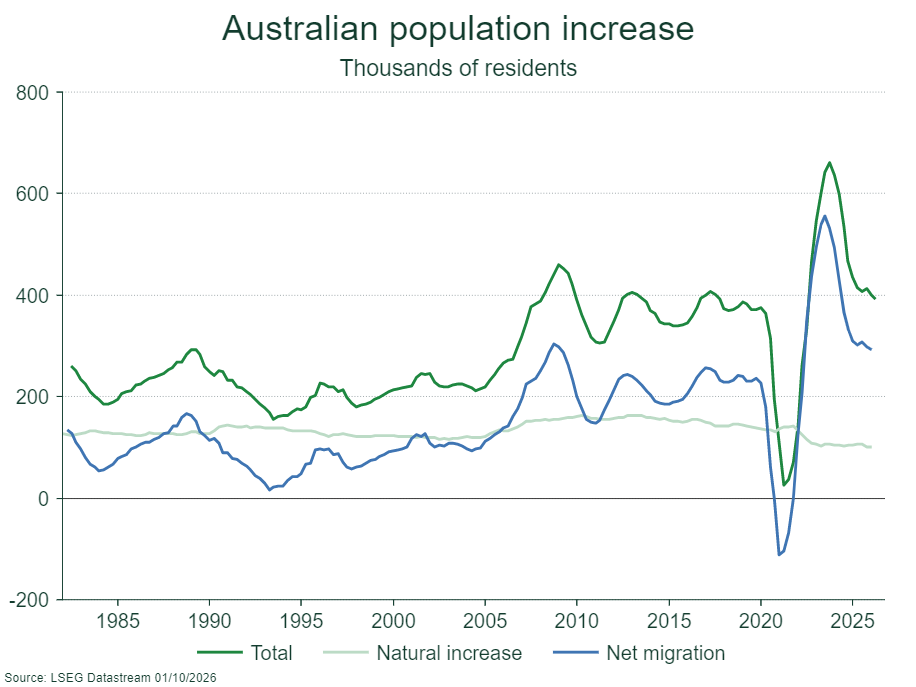
Yet beneath the improved budget outlook lies a major demographic shift. For the first time in Australia’s history, annual deaths are projected to exceed births within the 40-year period covered by the report. Birth rates continue to decline as Australians delay starting families and have fewer children. The fertility rate has been revised down since the last report to just 1.34 children per woman, well below the level required to maintain population growth naturally.
As a result, immigration becomes increasingly important to Australia’s economic future. Treasury expects net overseas migration to remain the primary source of population growth, forecast at 235,000 people per year, providing much of the expansion in the working-age population over coming decades. Without migration, Australia’s labour force would begin to stagnate at precisely the same time the number of retirees accelerates.
This demographic transition carries significant economic consequences. The number of Australians aged over 85 is expected to triple over the next four decades, from 625,000 to 1.9 million, driving a sharp rise in spending on healthcare and aged care services. While spending restraint is forecast to improve the fiscal outlook, government expenditure is still projected to grow steadily as the population ages.
The burden of funding this transition will increasingly fall on working-age Australians. Fuel excise revenues are expected to decline as electric vehicles become more widespread, while overall tax receipts remain constrained. Consequently, personal income tax is forecast to shoulder a growing share of government revenue. In effect, fewer workers will be supporting a larger cohort of retirees while simultaneously facing some of the highest housing costs in the developed world.
The housing data highlights the emergence of an intergenerational equity divide. For younger generations, the promise of “The Lucky Country” feels broken as home ownership among 25-to-34-year-olds has dropped 17 percentage points over four decades, leaving 250,000 fewer young households owning their homes and creating a widening wealth gap as older generations continue to benefit from rising asset values.
The most striking aspect of the report, however, is that Treasury’s fiscal projections rely heavily on an outcome that has proven elusive for much of the past decade: stronger productivity growth. Australia’s productivity performance, measured in terms of GDP per hour worked, has largely remained unchanged since 2019. Yet the Intergenerational Report assumes labour productivity returns to a long-run growth rate of 1.2% per annum. That assumption may sound modest, but it has become the single most important variable underpinning the nation’s long-term fiscal position.
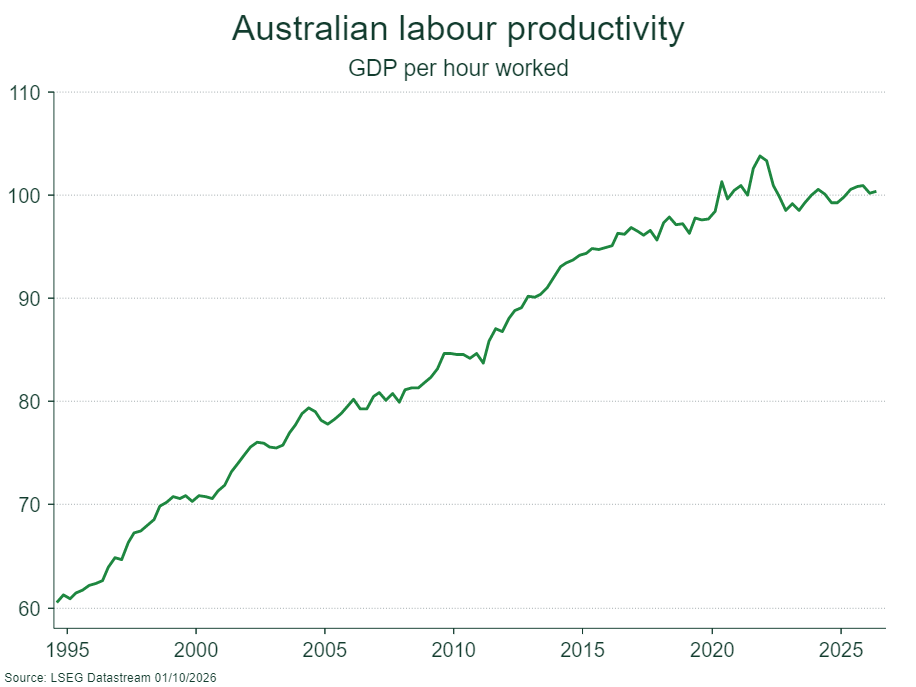
Increasingly, Treasury is looking to artificial intelligence (AI) to help deliver this outcome, assuming technological adoption and efficiency gains from AI will contribute meaningfully to future productivity improvements. The entire fiscal outlook and level of debt in 40 years becomes very sensitive to whether this productivity growth materialises. If productivity growth averages only 0.8% per annum, government debt is projected to more than double relative to Treasury’s central forecast over the coming decades. Conversely, if technological advances, including AI adoption, lift productivity growth to 1.6% per annum, government debt is essentially eliminated by 2066. In effect, Australia’s long-term fiscal projections are becoming increasingly dependent on a technology that remains largely unproven at economy-wide scale.
Critics, such as former Treasurer Peter Costello, argue that Treasury’s central assumption that productivity will magically rebound to 1.2% per year is a form of “fantasy economics” that relies on AI and avoids tough structural reforms in tax, workplace relations, and regulation that could help lift productivity. A broad consensus of business leaders, financial columnists, and younger Australians argue that the country is living off the fat of previous reform eras, where high immigration masked weak productivity growth. Business Council of Australia analysis shows that productivity failure has already left the average Australian $2,000 poorer per year than anticipated in 2023.
The report also highlights risks that are difficult to quantify. Treasury assumes climate change will have only a modest impact on agricultural productivity and economic growth over the next four decades. Critics argue such assumptions may underestimate the potential for more severe environmental disruptions and their associated economic costs. In addition, the report notes that geopolitical fragmentation is likely to be a major transition reshaping Australia’s economic and fiscal trajectory over the next 40 years, with more frequent conflicts and higher defence spending as well as ongoing restructuring of supply chains away from lowest cost to greatest security of supply.
Ultimately, the Intergenerational Report presents a future that is neither alarming nor particularly comforting. Australia’s fiscal outlook has improved, helped by assumptions that NDIS and aged care spending growth will be contained, but the nation is simultaneously becoming older, growing more slowly and increasingly dependent on immigration and productivity gains to sustain living standards.
For decades, strong population growth helped mask economic weaknesses by continually expanding the size of the workforce and consumer base. As that demographic tailwind fades, productivity becomes far more important and the next forty years will not be driven by population growth alone, but by whether technological innovation, particularly artificial intelligence, can generate the productivity gains required to support an ageing nation.
By Nick Ryder, Chief Investment Officer
Global Growth Remaining Resilient in the Face of Uncertainty
Over the past year, global markets have been confronted by war, energy supply shocks, rising government debt, and renewed concerns about inflation. Yet amid all this uncertainty, the global economy has remained resilient. Earlier this month, the OECD delivered its latest economic outlook report, where it upgraded its outlook for global growth, forecasting the world economy to expand by 2.9% in 2026. While this is below the pace seen in recent years, it is a stronger outcome than many economists anticipated given the challenges facing global markets. The OECD noted that despite the energy shock stemming from the conflict in the Middle East, and the Russia/Ukraine war, economic activity has held up better than expected, supported by government stimulus, alternative energy supplies, and robust investment activity.
Throughout the report, the OECD referenced the growing role that artificial intelligence is playing in the global economy. The OECD identified AI-related investment as a major contributor to production, trade and economic growth, highlighting the significant capital being deployed into data centres, semiconductors, cloud infrastructure and digital services. Just as the internet transformed economies over time, AI has the potential to increase efficiency across industries, improve competitiveness and support long-term growth. While the ultimate benefits remain uncertain, the scale of investment suggests this trend is unlikely to disappear anytime soon.
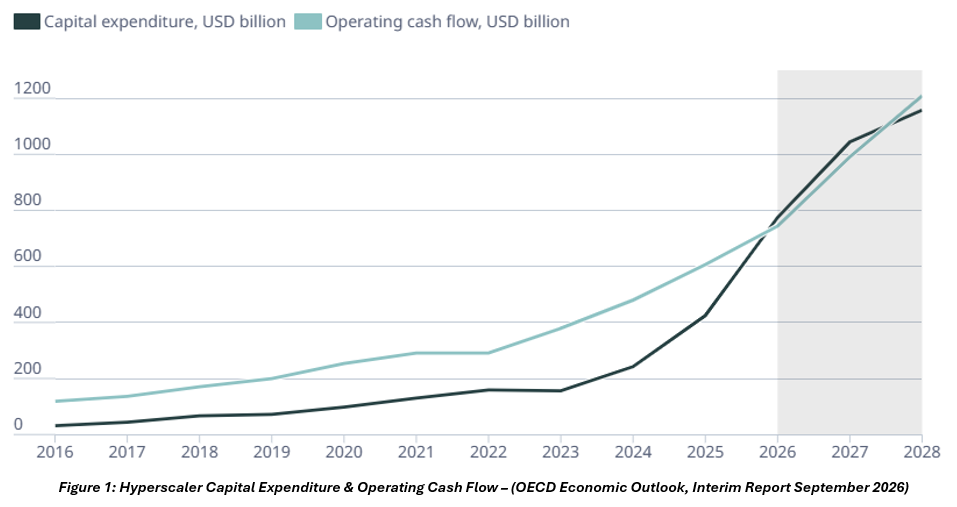
While the OECD upgraded its growth outlook, it also cautioned that investors should remain mindful of the risks gripping the global economy. Energy markets remain vulnerable to geopolitical developments, inflation continues to exceed central bank targets in many regions, and bond yields have risen materially as policymakers seek to contain persistent price pressures. The OECD also highlighted a number of downside risks, including weather-related disruptions, further increases in borrowing costs, and the possibility that the significant investment currently being directed towards artificial intelligence may not generate the productivity gains many are anticipating.
While the short-term risks remain elevated, the global economy continues to demonstrate resilience, supported by solid corporate earnings, ongoing business investment and healthy consumer demand. With this in mind, investors should look beyond the doom and gloom news headlines warning of market bubbles and crashes and instead focus on the underlying fundamentals driving global markets. Stock market ‘bubble’ concerns have been prevalent for several years now, and any action by investors to reduce their equity exposure during that time, would have resulted in significant underperformance, particularly as equity markets have continued to reach new highs and enthusiasm around artificial intelligence has increased. A disciplined investment approach is warranted, one with less focus on short-term headlines and more focus on remaining invested, managing risk appropriately and maintaining exposure to the long-term drivers of economic growth, which is corporate earnings and profitability.
By Joseph Nakhoul, Investment Research Analyst
Australia Joins the AI Revolution
As artificial intelligence continues to reshape the global economy, we are seeing the investment opportunity broaden beyond the companies developing AI models and semiconductors to the infrastructure required to power them. Firmus, the Australian technology and data centre business preparing to list on the ASX later this month, is a particularly interesting example. With an IPO targeting approximately US$5 billion and a potential valuation of between US$30 billion and US$40 billion, Firmus could become one of the largest listings in Australian history.
Firmus provides exposure to an area of the AI ecosystem that has been largely inaccessible to public market investors in Australia, the physical infrastructure required to support the enormous computing demands of AI. Firmus operates AI-focused data centres designed to provide high performance computing capacity to hyperscalers and major technology companies, with relationships including NVIDIA and Meta. Global institutional investors have also provided substantial backing, including Blackstone, Coatue and Jane Street.
Firmus currently operates two data centres, with further facilities under development across Australia and the broader Asia-Pacific region. Once these projects are completed, the company is expected to be generating approximately US$13 billion in revenue and US$12 billion of EBITDA. On these forecasts, that would imply an EBITDA margin of around 90%, highlighting the potentially attractive economics of specialised AI infrastructure once it reaches scale. However, these figures are projections and not yet established results. Currently, Firmus remains a capital intensive and loss making business, with the company reportedly expecting an after tax loss of US$77 million in the first half of the 2027 financial year. Significant capital will need to be invested before the full earnings potential of the business can be realised. The IPO proceeds are therefore intended to fund further development and accelerate the expansion of its data centre network.
This is an important consideration when assessing the broader AI investment theme. There has been substantial capital flowing into AI infrastructure, but returns will depend on whether today’s investment translates into sustainable demand and profitability in the future. Electricity availability, construction costs, financing conditions, technological change and the willingness of major technology companies to continue increasing their AI expenditure will all influence this outcome.
From an Australian market perspective, Firmus is a notable development. Until now, investors seeking exposure to the global AI investment cycle have largely been forced offshore, with the dominant opportunities concentrated in the United States and parts of Asia, particularly Taiwan and South Korea. Firmus has the potential to become one of Australia’s first major listed companies directly linked to the infrastructure powering artificial intelligence. Its emergence is a sign that the AI investment opportunity is beginning to broaden beyond the US, giving local investors a new way to participate in one of the most significant technological themes of the decade.
That said, enthusiasm should be balanced with discipline. Like many companies positioned at the centre of a powerful growth narrative, Firmus faces exceptionally high expectations. To the point where some hedge funds are reportedly preparing to take short positions in the company, under the assumption that these high expectations will not be met. Firmus will undoubtedly be an interesting company to watch as it enters the public market, but investors should remember that it is unlikely to be the last opportunity to gain exposure to the long-term growth of AI.
By Joseph Nakhoul, Investment Research Analyst
Philanthropy – Planning Giving Choices
Introduction
Australians have a strong tradition of supporting their communities through charitable giving.
While many people donate directly to charities or volunteer their time, those wishing to make a more significant or long-term impact may benefit from a structured giving solution. For example, creating an ongoing charitable legacy by establishing a private or public giving fund.
Private or Public Giving Fund?
Giving funds are tax exempt charitable foundations that distribute money to approved charities endorsed as deductible gift recipients (DGRs). They attract donors who need both a tax deduction and wish to make a lasting impact for a cause that is important to them and/or wish to involve the next generation.
Donors receive an immediate tax deduction for the amount donated but retain the flexibility to distribute the funds to charity later. The money is invested and the returns generated are tax free within the Fund. This offers a style of giving that allows you to both give whilst potentially growing money for charity.
Private Giving Fund (PGF)
A PGF is a good option for those who want full control over the administration of their Fund and have a minimum of $1M to contribute (given associated running costs).
Donors can act as Trustee of the Fund and assume full responsibility for the Foundation’s administration, investment and governance activities. Robust guidelines and reporting obligations apply, which is attended to by a specialist administrator who also handle the day-to-day compliance and administration.
Public Giving Fund (PuGF)
A PuGF is a giving account within a larger public charitable foundation. It is established quickly by making a smaller donation (e.g. $20,000) which is set aside in your own named giving fund. All administration, investment and governance activities are undertaken by a Trustee for fixed fee.
The donor’s sole responsibility is to select charities they would like to see supported each year.
It is a great option for those who:
- Have an interest in giving, but do not want the responsibility of administering the structure.
- Are looking at a lower entry point to structured giving. A giving fund can be established from $20,000.
Advantages of a PuGF
- Less money to establish – the PuGF acts as an aggregator to provide access to a deductible charitable foundation without the large size of funds required for a Private Giving Fund (PGF).
- Simple & less time consuming – as the trustee already exists and handles the administration, investment and compliance matters, the donor can focus on the granting.
- Quick to set-up – A sub-fund can be established immediately, as there is no requirement to set-up a new trust or trustee company. A donor simply opens a new ‘sub-fund’.
- Tailored – a donor can name the sub-fund and grants made to charities will refer to this name. Anonymous grants are also possible.
- Tax benefits – money donated is usually tax deductible in the year made (or can be spread over a period of up to 5 tax years). It is a tax-exempt structure, so the philanthropic dollar goes further.
- Portability – it is possible to transfer assets from a PuGF into a PGF down the track.
Who can donate to a PuGF?
A PuGF purpose is to collect donations from the public so anyone can donate and there are no limits on the amount donated. The founder can also contribute to their giving fund as often or infrequently as they like. Once made the donations are irrevocable.
This is contrasted to a PGF which cannot seek donations from the public. A PGF also has a cap on the amount of donations it can accept from people other than the founder, relatives, associates or employees of the founder (as well as their estates).
How does a PuGF make grants?
The mandatory minimum annual grant is presently 4% of the opening 30 June net asset value of the total PuGF. It is proposed to increase to 6% for both Public and Private Giving Funds (this is not yet law).
The Trustee will advise the specific grant for your sub-fund each year, but you can choose to distribute in excess of this minimum. Grants are presented to the Trustee for approval and must be to an eligible Deductible Gift Recipient (DGR) endorsed as DGR Item 1 by the ATO. The grant recipient must also be a registered charity with the Australian Charities and Not-for-profits Commission (ACNC).
How much control do I have as a donor in a PuGF?
The Board of Trustees of the PuGF has complete control over all aspects of the investments held and has the final decision on grants. Thus donors who establish sub-funds are not entitled to direct, but only to recommend, the disbursement of these funds. It is rare for the Trustee to reject a valid grant. The Trustee may however undertake its own due diligence on the recommended charity before approving a grant recommendation and typically impose a small minimum grant of $1,000.
How are my funds invested in a PuGF?
All monies in a PuGF are generally managed as a single investment portfolio in line with a documented investment strategy. The Trustee’s investment decisions factor in the mandatory annual minimum grants, plus considerations such as inflation, risk, liquidity, transaction costs and the benefits of diversification.
What happens on my death to my PuGF?
A PuGF can continue post your death, or you can instruct the Trustee’s to make a final grant and close the giving fund on your death. You can also nominate a successor to take over grant nominations, or you can leave a statement of wishes with the Trustee to continue your granting program as an annuity-style legacy into the future.
You can also use your Will to direct additional money to your giving fund. It is important that the clause in your Will is worded carefully to help avoid unintended tax implications.
What does it cost?
Generally, the fee charged for a PuGF is 1% – 1.50% p.a. of the value of the sub-fund. This is an all-encompassing fee covering running expenses such as administration, compliance and investment costs.
Getting Started with a PuGF?
There are several established Public Ancillary (gifting) Funds available to Australian donors, including the Stanford Brown Charitable Foundation, APS Foundation and Perpetual Foundation. Minimum starting donations range from $20,000 to $40,000 depending on the Foundation.
The most appropriate structure will depend on your charitable objectives, desired level of involvement and intended donation amount.
If you would like to explore whether a structured giving strategy is appropriate for you, please contact your Adviser.
By Todd Stanford, Private Wealth Adviser
Latest Podcast
SB Talks: Markets, Machines and the Middle East
This week on SB Talks, Vincent O’Neill and Nick Ryder discuss the Fed’s latest rate decision and what it means for inflation, interest rates and markets. They explore why policymakers remain focused on bringing inflation back to target, the growing risk that higher oil prices and Middle East tensions add further pressure, and the increasingly heated debate around AI safety, regulation and the race for technological dominance. A timely discussion on the economic and geopolitical forces shaping the investment landscape.
Listen on Apple Podcasts
Watch on Youtube: